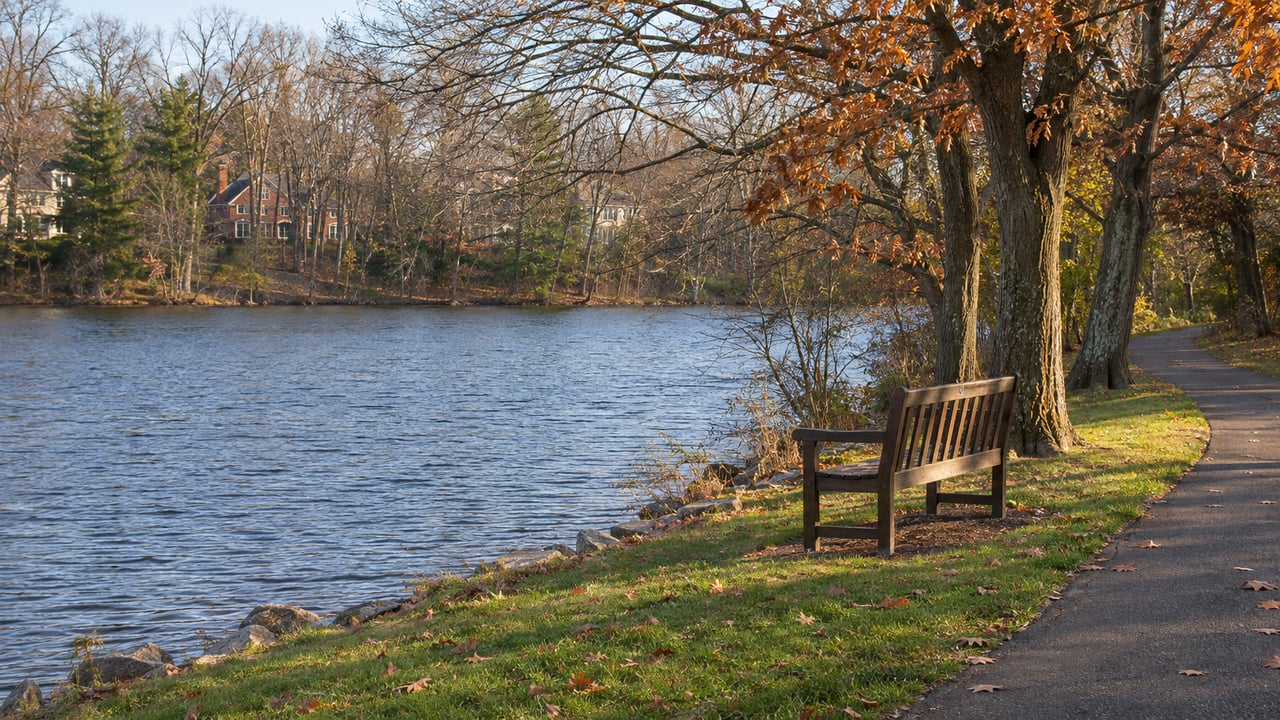
The AVCA's plan for this project lowers the western end of Ashburn Lake by 3 to 4 feet, leaving what the association calls a temporary "bathtub ring" of exposed bank, while pumps carry the lake's flow around the work zone. Safety fencing, heavy equipment and crew access points now line the area near the Ashburn Road Bridge. The November issue of The Villager reports that crews are dredging accumulated sediment out of the forebay basin.
When the work is done, Loudoun County plans to connect a trail under Ashburn Road. The Loudoun Times-Mirror reported that the underpass is one of the closures during construction and that the trail link comes at the end of the project. The closed trail you're detouring around this winter is the work that leads to that connection.
The Closed Stretch Runs From Rubles Mill Court to Roaming Shores Terrace
The AVCA project page names the trail from Rubles Mill Court to Roaming Shores Terrace as fully closed to pedestrians during construction. The November Villager confirms that segment is still closed. The October issue added two more pieces: part of the north trail near Ashburn Lake and the pedestrian walkway under the Ashburn Road bridge are both closed, and detour signs are posted around the work zone.
The rest of the network is open. Ashburn Village has 50 miles of trails and eight lakes and ponds, and the AVCA posts a community map on its amenities page. If your usual route ran along the north shore and under the bridge, follow the posted detour signs and check that map before you head out.
The AVCA lists standard construction hours as Monday through Friday, 7:00 a.m. to 4:00 p.m., and expects no weekend work. The fenced areas stay closed every day of the week. Outside the fences, though, a Saturday or Sunday walk this holiday weekend won't have machinery running next to it. Households closest to the work should expect heavy equipment noise during weekday hours. The AVCA also warns of temporary organic odors from the drained lakebed and exposed sediment.
The trails picked up new signs this fall, separate from the lake work. The AVCA installed regulatory and safety signage for e-bikes along key paths. E-bike riders must yield to pedestrians, keep a controlled speed, and give a bell or a verbal warning when passing from behind. With one stretch of lakeside trail closed, the open paths nearby are carrying the walkers and riders who used to spread out along it.
Why Loudoun County Is Digging in an Ashburn Village Lake
The work is a county stormwater project built in partnership with the AVCA. Ashburn Lake and its infrastructure are more than 35 years old. Decades of stormwater runoff have carried fertilizer, sediment and pollutants into the lake, and the AVCA ties that buildup to recurring algae blooms.
Michele Seib, a stormwater engineering manager with Loudoun County, explained the design to the Loudoun Times-Mirror. "We're scooping out the sediment that's come in and deposited, and the reason you want the forebay is it gives that sediment an initial spot to, like, fall out, so it's not falling out over the whole pond," she said. She also told the paper that Ashburn Lake is unusual because water flows through it constantly, and that steady flow is how sediment has built up over time.
So the forebay changes where sediment collects, which goes further than a single cleanup. Once it is built, sediment settles in a separated section of the lake where it can be removed later, so it no longer spreads across the whole lake. The cleaner water also matters downstream, because Ashburn Lake drains toward Beaverdam Run and on to the Chesapeake Bay.
Chris Stone, water programs division manager in Loudoun's Department of General Services, told the Times-Mirror that the county went looking for projects that worked for both sides. "The county will get what we need, and the community will get something out of it, too," he said.
Loudoun County's notice of award, dated March 20, 2026, gave the Ashburn Lake Pond Enhancements construction contract to Environmental Quality Resources LLC for $4,760,165.80. In February 2023 the county announced a state grant of $2,130,446 for the project, a 50/50 match from the Virginia Department of Environmental Quality's Stormwater Local Assistance Fund. The October Villager describes the forebay project as fully funded by Loudoun County and the state, at zero direct cost to Ashburn Village residents.
What the Lake Gets Back
Most of what is being built will sit below the waterline when it's finished, so it helps to know what to look for afterward. The AVCA project page lists the pieces.
The small island on the western side of the lake will be re-formed on the northern shoreline, a move meant to improve how water flows through the lake. After dredging, a 10-foot-wide aquatic bench will run along the shoreline, set from 0 to 18 inches under the surface and planted entirely with native Virginia aquatic species. A stone weir wall will filter moving water. It will stay deep enough underwater that canoes and kayaks can pass over it, so paddling on Ashburn Lake continues once the project is done. All trails disturbed inside the work zone are to be fully rebuilt. The county's bid scope also includes asphalt trail replacement and access road improvements.
New aerators will be added to raise oxygen levels in the water and cut down on algae growth. The AVCA also lists specialized fishing spots along the stabilized shorelines among the long-term results. Then there is the connection under Ashburn Road, which the Times-Mirror reported the county will build at the end of the project.
The timeline is long. The AVCA project page estimates 18 to 24 months of construction and points to completion in 2028. Plan on this winter, next summer's pool season and at least one more fall with the closure in place.
Separate Dam Work Is Planned at Three Lakes
A second project, separate from the forebay, covers the community's three state-regulated dams at Ashburn Lake, Pavilion Lake and Tippecanoe Lake. The October Villager calls it the Ashburn Village Dam Overtopping Protection project and describes the work as reinforcing the dam slopes against erosion.
The plan, with Gordon U.S. Engineers, is to install HydroTurf, an engineered synthetic turf system, along the downstream embankments. The existing growth on those embankments has to be cleared first. Native trees will be replanted afterward, including Red Maples, Willow Oaks and American Hollies, along with native shrubs. The October Villager listed November as the target start. If an embankment near one of your regular routes is suddenly bare, this project is why, and the replanting comes next.
Pavilion Lake has its own work on a smaller scale. The AVCA secured a $50,000 Loudoun County grant for removing invasive plants around Pavilion Lake and restoring its natural habitat. That is part of a broader effort by the AVCA Landscaping Committee. It also includes pollinator gardens and the removal of about 1,300 invasive Tree of Heaven plants last year by the Ashburn Village Invasive Removal Team. This fall, Ashburn Village also received 130 native plants through a donation from Jim Knowles and Abernethy & Spencer Greenhouse and Garden Center, shared with eight other Loudoun communities.
A Lake Worth Photographing Before It Changes
Ashburn Village turns 40 in 2027. A 40th Anniversary Commission of resident volunteers held its first meeting in September and is collecting residents' memories and historic photos for the celebrations, with a submission form in the November Villager. The west end of Ashburn Lake will look different once the island moves north and the planted bench fills in. A photo of the lake with its old island, or of this winter's lowered water, fits that collection. Questions about the work go to the AVCA at [email protected], and the county keeps its own Ashburn Lake Forebay Retrofit Project page.
If you live near the lake and want to talk through how two years of construction fits your own plans, whether that means staying put or timing a move, Sell Buy NOVA Homes is glad to talk it through with you. Let's Connect.